MirrorWorld Taming Video Diffusion Models for Mirror Reflection Generation

Youjun Zhao1 Alex Warren2 Gary K.L. Tam2 Rynson W.H. Lau1

1City University of Hong Kong 2Swansea University

Paper overview

Overview

Abstract

Recent advances in video diffusion models (VDMs) have enabled high-fidelity video synthesis. However, generating mirror reflections remains challenging because the content within a mirror must remain consistent with the surrounding scene. Existing VDMs are not specifically designed to model scene-to-mirror relationships, which can lead to reflections with incorrect content or inconsistent spatial arrangements. We observe that mirror reflection generation involves two complementary challenges: determining what scene content should be reflected and how the reflected content should be spatially arranged within the mirror region. Motivated by this observation, we propose MirrorWorld, a reflection-aware video inpainting framework that models scene-to-mirror relationships during generation. Specifically, we introduce Semantic Relation Distillation (SRD), which transfers relational information from a frozen visual foundation model to encourage semantic associations between visible scene content and mirror regions. We further propose Geometric Transformation Alignment (GTA), which learns a transformation that guides the spatial arrangement of reflected content. The two components play complementary roles, with SRD modeling what should be reflected and GTA modeling how it should be arranged. To facilitate research on this problem, we construct a benchmark for video mirror reflection generation by repurposing four existing video mirror datasets into a unified reflection reconstruction task. Experimental results show that MirrorWorld achieves improved reflection reconstruction quality over representative image-based reflection generation methods and strong video inpainting baselines.
The task

From a masked mirror to a faithful reflection.

MirrorWorld reconstructs the missing mirror region while preserving its semantic and geometric relationship with the visible scene.

Input video with mask
Generated video
Input video with mask
Generated video

Method

What to reflect.
How to reflect it.

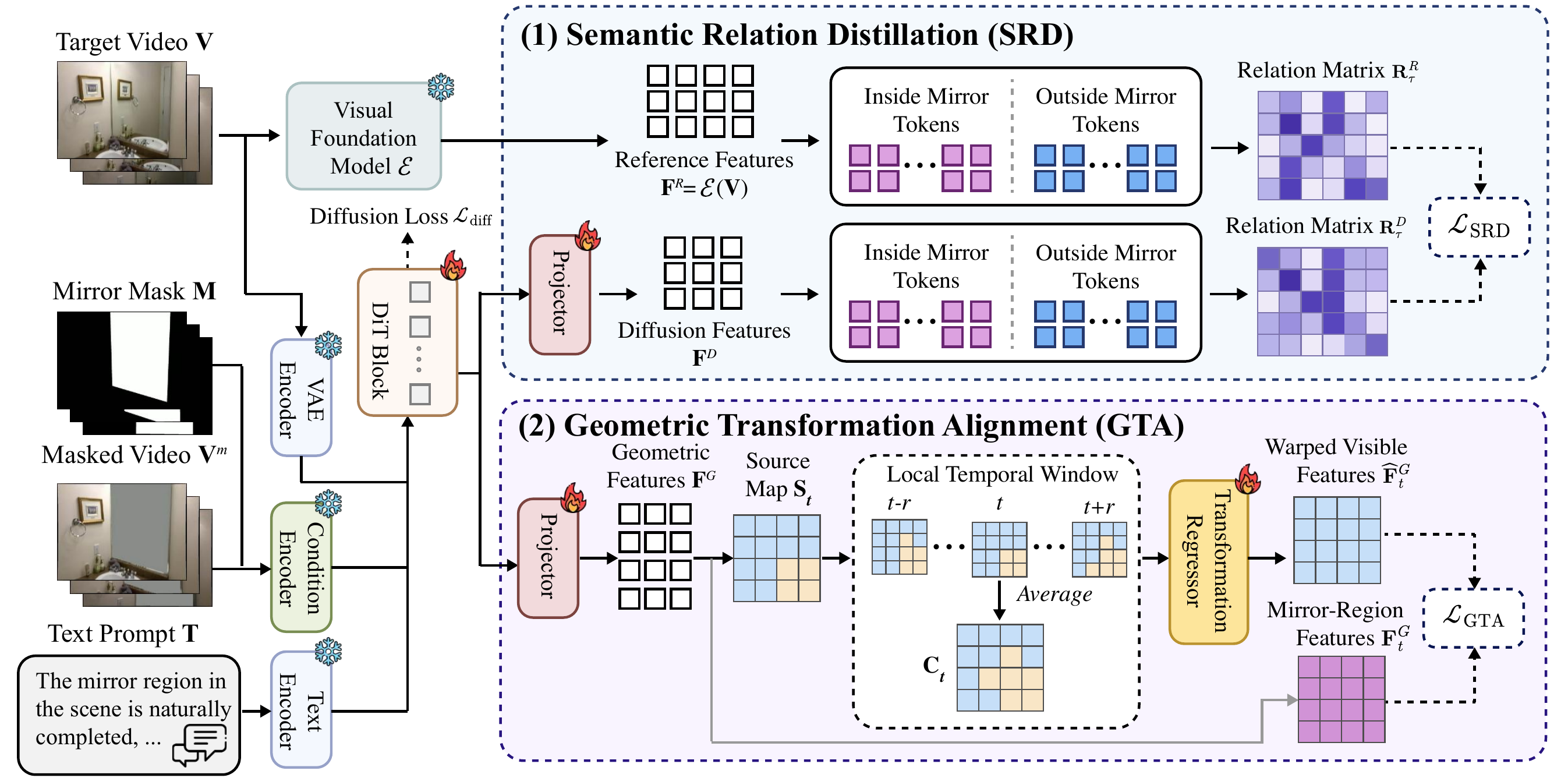
Two complementary training objectives align the visible scene and mirror region. Auxiliary modules are used during training; inference retains the adapted video generator.

MirrorWorld architecture with Semantic Relation Distillation and Geometric Transformation Alignment
MirrorWorld trains a Wan2.1-VACE-14B backbone with reflection-specific semantic and geometric supervision.

01 / What

Semantic Relation Distillation (SRD)

SRD uses a frozen VideoMAEv2 visual foundation model as a relational reference. It aligns cosine-similarity relations between mirror-region tokens and visible-scene tokens, teaching the diffusion representation which surrounding content is semantically associated with the missing reflection.

Semantic association

02 / How

Geometric Transformation Alignment (GTA)

GTA builds a source feature map from visible-scene tokens and predicts an affine feature-space transformation from a local five-frame context. The current-frame features are then differentiably warped into the mirror region, constraining where the associated content should appear while keeping the geometry temporally stable.

Spatial arrangement

Qualitative comparison

From Implausible to Plausible

Given the same masked video and text prompt, existing video inpainting methods can produce plausible-looking scenes while placing the wrong content inside the mirror. MirrorWorld restores the scene-to-mirror relationship and preserves the reflection across time.

Video mirror reconstruction

Wan2.2-A14B

Input video
with mask
MirrorFusion
Image-based
MirrorVerse
Image-based
VideoPainter
Video inpainting
VACE
Video inpainting
MirrorWorld
Ours

More MirrorWorld results

Generated Reflection

Video with mask

Generated video

Video with mask

Generated video

Video with mask

Generated video

Video with mask

Generated video

Video with mask

Generated video

Video with mask

Generated video

More Mirrors? Let's try!

Video with mask

Generated video

Video with mask

Generated video

Video with mask

Generated video

Citation

BibTeX

BibTeX entry for the MirrorWorld arXiv preprint.

@misc{mirrorworld,
  title        = {MirrorWorld: Taming Video Diffusion Models for Mirror Reflection Generation},
  author       = {Youjun Zhao and Alex Warren and Gary K. L. Tam and Rynson W. H. Lau},
  year         = {2026},
  eprint       = {2608.07463},
  archivePrefix = {arXiv},
  primaryClass = {cs.CV},
  url          = {https://arxiv.org/abs/2608.07463},
}